
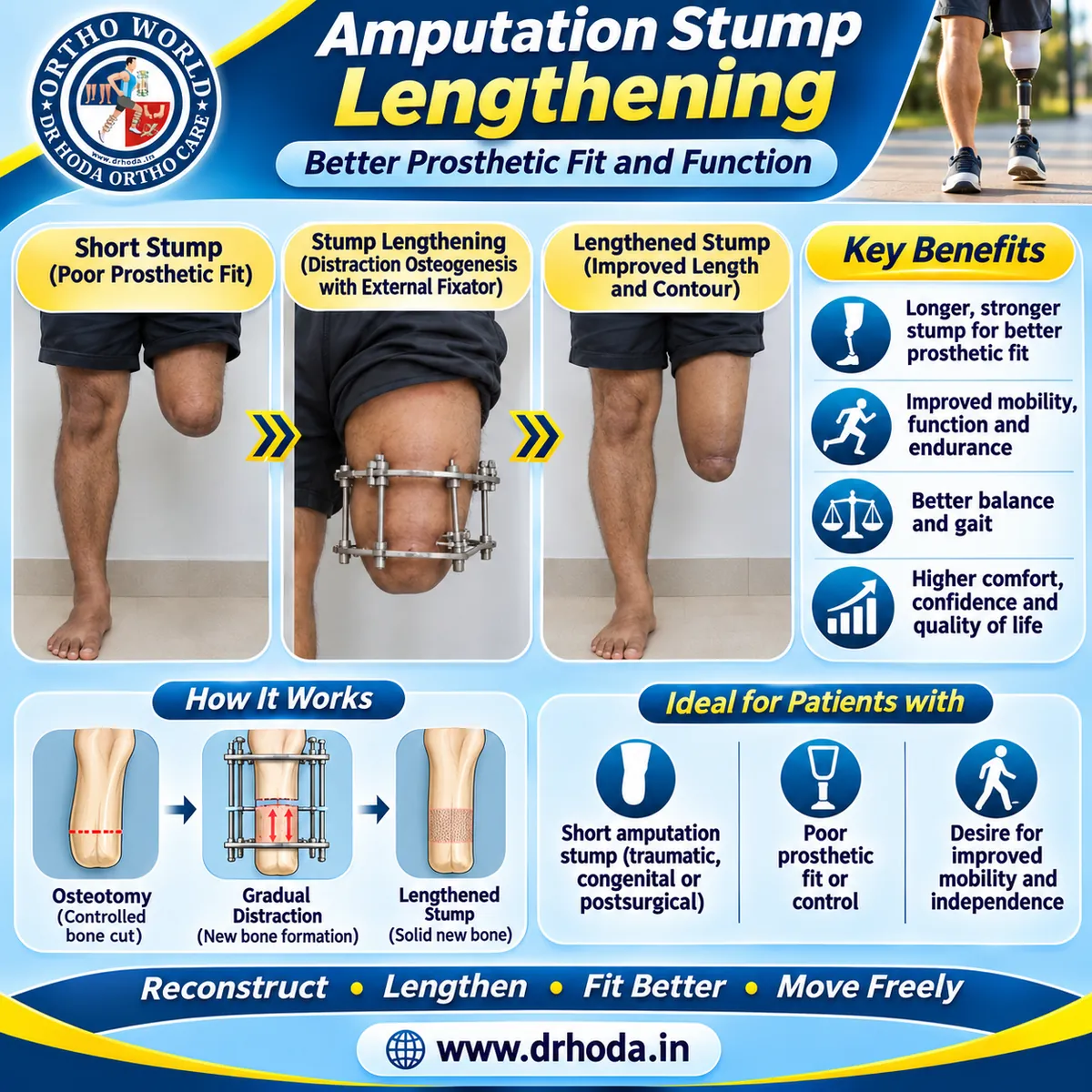
After an amputation, the length and quality of the remaining limb (the stump or residual limb) decide how well an artificial limb fits and how much control the person has. A very short stump can make a prosthesis loose, painful or impossible to use, and sometimes forces a higher-level amputation. Stump lengthening uses gradual bone-lengthening techniques to add length to a short stump.
Who may benefit
- A short below-knee stump that struggles to hold a prosthesis or control the knee
- A short above-knee stump with poor prosthetic control and walking
- A short forearm or upper-arm stump where extra length improves prosthetic use
- Children whose stump has grown less than the rest of the body
- Patients advised a higher amputation because the stump is too short, where lengthening may preserve a joint
How it works
An external frame (Ilizarov type) is applied to the stump. The bone is cut and gradually lengthened, typically about a millimetre a day, so that new bone forms. The soft tissue at the end of the stump, which must cushion the prosthesis, is protected and may need its own reconstruction. Once the target length is reached, the frame stays on until the new bone has hardened, after which the frame is removed and prosthetic fitting begins.
Evaluation before surgery
- Stump length, bone quality and soft-tissue cover
- Skin, scars, previous infection and nerve pain (neuromas)
- Joint movement above the stump – a stiff knee or hip limits the benefit
- X-rays of the stump and the joint above
- Assessment with your prosthetist of what length and shape will make the biggest difference
- Your goals and ability to attend regular follow-up
Possible complications
Pin-site infection, slow or weak new bone, pressure or breakdown of the skin at the stump end, stiffness of the joint above, and the need for further soft-tissue surgery before a prosthesis can be worn. Treatment takes months, and prosthetic training continues afterwards.
The team approach
Stump lengthening works best when the surgeon, prosthetist and physiotherapist plan together. The aim is not simply more length, but a stump that is strong, well-cushioned and shaped for a comfortable, controllable prosthesis.
Frequently asked questions
Can stump lengthening avoid a higher amputation? In selected cases, yes – by gaining enough length to save the knee or elbow.
Will I need a new prosthesis? Usually yes, fitted to the new length after healing.
Watch on our YouTube channel
 ▶
 ▶
Ready to discuss your case?
Book a consultation in Patna or Hajipur, or send your X-rays on WhatsApp for an initial opinion.
