
Congenital Limb Deficiencies in Children
Children born with a short, bent or incompletely formed limb need long-term planning through growth. Treatment combines bracing, guided growth, deformity correction and limb lengthening at the right ages.
On this page
Conditions we treatWhen should parents seek advice?How is it treated?Other options we will discussWhat to expectOur patientsRisks and limitationsFAQConditions we treat
- Congenital pseudarthrosis of the tibia (CPT) – a bowed shin bone that breaks and does not heal
- Fibular hemimelia – partial or complete absence of the fibula, with a short leg and foot deformity
- Congenital short femur / proximal femoral focal deficiency (PFFD)
- Tibial hemimelia
- Radial club hand – absent or short radius with a bent wrist
- Achondroplasia and other skeletal dysplasias – short stature with bowed legs
- Short fingers and toes (brachydactyly)
When should parents seek advice?
- One leg shorter than the other
- A bowed shin bone, especially with café-au-lait skin patches
- An abnormal foot or missing toes
- A crooked wrist or short forearm
- Bowed legs with short stature
Early assessment allows growth to be predicted and treatment to be planned at the right time.
How is it treated?
- Assessment – examination, X-rays and prediction of leg-length difference at maturity.
- Protection and bracing – especially for CPT before any fracture.
- Guided growth – small plates to straighten bones gradually during growth.
- Deformity correction and lengthening – Ilizarov or other fixators, usually in stages through childhood.
- Long-term follow-up until growth is complete.
Other options we will discuss
Bracing and protection · staged treatment through growth · shoe raise or orthosis · prosthesis in selected severe cases – chosen together with the family.
What to expect
Most conditions need more than one treatment stage across childhood. We explain a long-term plan to the family at the start.
Our patients
Dr. Hoda’s own patients, shared with consent for education; faces and names are hidden. Results vary from patient to patient. Contains clinical and operative images.
A child-onset condition treated after years of suffering.
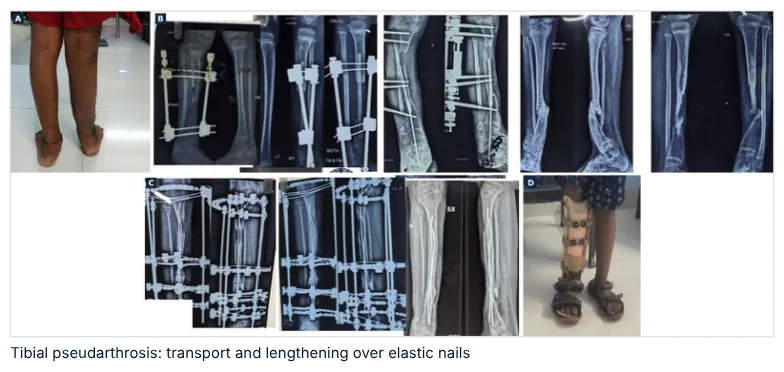
From the free textbook Ilizarov Principles & Limb Reconstruction – Chapter 149 · Chapter 147 · More in Clinical Cases.
Risks and limitations
Recurrence of deformity during growth, refracture (especially in CPT), stiffness, pin-site infection and the need for further surgery. Dr. Hoda will explain the plan and risks for your child.
Watch
 ▶
 ▶
 ▶
 ▶
 ▶
 ▶
When to call us immediately
Redness, pus or bad smell around a wound or pin · fever · increasing pain, numbness or tingling · a loose or broken wire, pin or ring · cold, pale or blue toes or fingers.
Patna +91 77658 67111 · Hajipur 24-hour emergency +91 70704 61111
Frequently asked questions
At what age should treatment start?
How much can a leg be lengthened?
Will my child need many operations?
Can my child go to school during treatment?
A note from Dr. Shamsul Hoda
Every limb and every patient is different. We plan carefully, explain the options honestly and stay with you through recovery.
Related
Limb Lengthening · Deformity Correction · Clubfoot · Read: congenital pseudarthrosis tibia · Read: achondroplasia limb lengthening · Read: radial club hand · Read: finger toe lengthening
Ready to discuss your case?
Book a consultation in Patna or Hajipur, or send your X-rays on WhatsApp for an initial opinion.
