
Limb Lengthening Surgery in Patna
Limb lengthening slowly grows new bone to make a short leg or arm longer, or to even out legs of different lengths. Treatment is planned and carried out by Ilizarov and limb-reconstruction surgeon Dr. Shamsul Hoda at Ortho World, Patna and Hajipur.
On this page
What is limb lengthening?Who may need it?Is limb lengthening the right choice? Other optionsHow much can a bone be lengthened?The lengthening process – step by stepTypes of devicesPost-polio limb shortening and deformityBefore surgeryAfter surgery and at homeHow long does treatment take?Benefits and risksWill the lengthened limb work well?Our patientsTreatment in Patna & HajipurFAQ- New bone is grown slowly – about 1 mm a day – after a planned bone cut.
- Used for short limbs after polio, fracture, infection, growth problems and birth conditions.
- Bowing or twisting can be corrected in the same treatment.
- Every treatment is planned on full-length X-rays and explained to you before surgery.
What is limb lengthening?
It is a planned operation in which a bone is carefully cut and then very slowly pulled apart with a frame or a special nail. The body fills the gap with new, living bone. Muscles, nerves, blood vessels and skin stretch gradually at the same time. The thigh bone (femur), shin bone (tibia), upper-arm bone (humerus) and forearm bones can all be lengthened.
Who may need it?
- One leg shorter than the other (limb length discrepancy)
- Shortening after polio, a fracture, infection or growth-plate injury
- Children born with short limbs – congenital short femur, fibular hemimelia, tibial hemimelia
- Achondroplasia and other skeletal dysplasias
- Short arm or forearm, short fingers or toes, short amputation stump
- Shortening together with bowing or twisting of the bone – both can be corrected at once
See all conditions in the Conditions A–Z.
Is limb lengthening the right choice? Other options
Not every difference in length needs surgery. Depending on age and the amount of shortening, options include:
- Shoe raise – often enough for small differences (usually up to about 2 cm)
- Slowing growth of the longer leg in a growing child (epiphysiodesis)
- Shortening the longer leg in selected adults
- Prosthesis or orthosis for very large differences or severely affected limbs
- Limb lengthening – when the difference is larger, or when deformity also needs correction
We discuss every option with you and your family, and decide together.
How much can a bone be lengthened?
The amount depends on the bone, age, the cause of shortening and the health of the muscles and joints. Moderate lengthening is usually done in one stage. Larger differences are often corrected in two or more stages, sometimes years apart in children. We explain the realistic goal for you before treatment.
The lengthening process – step by step
- Assessment and planning – examination, full-length standing X-rays and a digital plan of the bone cut and frame (how we plan).
- Surgery – under anaesthesia, the frame or nail is fixed and a small bone cut (corticotomy or osteotomy) is made. Tight tendons may be released at the same time.
- Rest phase (latency) – about 5–7 days, while healing begins.
- Lengthening phase (distraction) – about 1 mm a day, usually in 3–4 small turns. You or a family member are taught to do this at home. X-rays every 1–2 weeks check the new bone and nearby joints.
- Healing phase (consolidation) – lengthening stops and the new bone hardens. Walking and physiotherapy continue. This phase usually takes longer than the lengthening phase.
- Device removal – once the new bone is strong on X-ray, the frame is removed, usually as a short procedure. A cast or brace may be used for a few weeks.
- Rehabilitation – strengthening, joint movement and walking training.
Why the speed matters
- Too slow – the new bone can harden too early and stop the lengthening.
- Too fast – the new bone can be weak, and muscles and nerves can become tight or irritated.
We adjust the speed according to X-rays and your examination at every visit.
What happens to muscles, nerves and skin?
They stretch slowly, a little every day. Daily stretching exercises and physiotherapy keep the knee, ankle and hip moving. If a joint becomes tight, we slow down, increase therapy or, rarely, release the tight tissue.
Types of devices
| Device | How it works | Often used for | Points to know |
|---|---|---|---|
| Ilizarov circular frame | Rings and fine wires around the limb | Most conditions, including deformity, infection or poor bone | Our main tool; very versatile |
| Hexapod (six-axis) frame | Ring frame with six struts set from a computer plan | Selected complex deformities | Used for selected cases |
| Rail (monolateral) fixator | One bar on the side of the limb | Femur lengthening, bone transport | Lighter; less suited to complex deformity |
| Lengthening over nail (LON) | Frame for lengthening + nail inside the bone | Selected adolescents and adults | Frame comes off earlier |
| Lengthening over plate | Frame for lengthening + plate on the bone | Narrow or curved canals, children, lengthening with knee deformity correction | Frame comes off earlier; plate protects the new bone |
How we choose the method
- Classical Ilizarov frame – our main tool, especially when lengthening is combined with deformity, infection, poor bone or a stiff joint.
- Lengthening over nail – for the thigh bone when the canal is fairly straight and wide enough for a strong nail (usually 8 mm or more). The frame can come off once the length is reached.
- Lengthening over plate – when the canal is narrow or curved, in children, or when a knee deformity is corrected at the same time.
- Lengthening over flexible (TENS) nails – in selected children and adolescents.
- Hexapod frame – for selected complex deformities.
The final choice depends on your X-rays, age, bone quality and deformity – we explain it to you before surgery.
Post-polio limb shortening and deformity
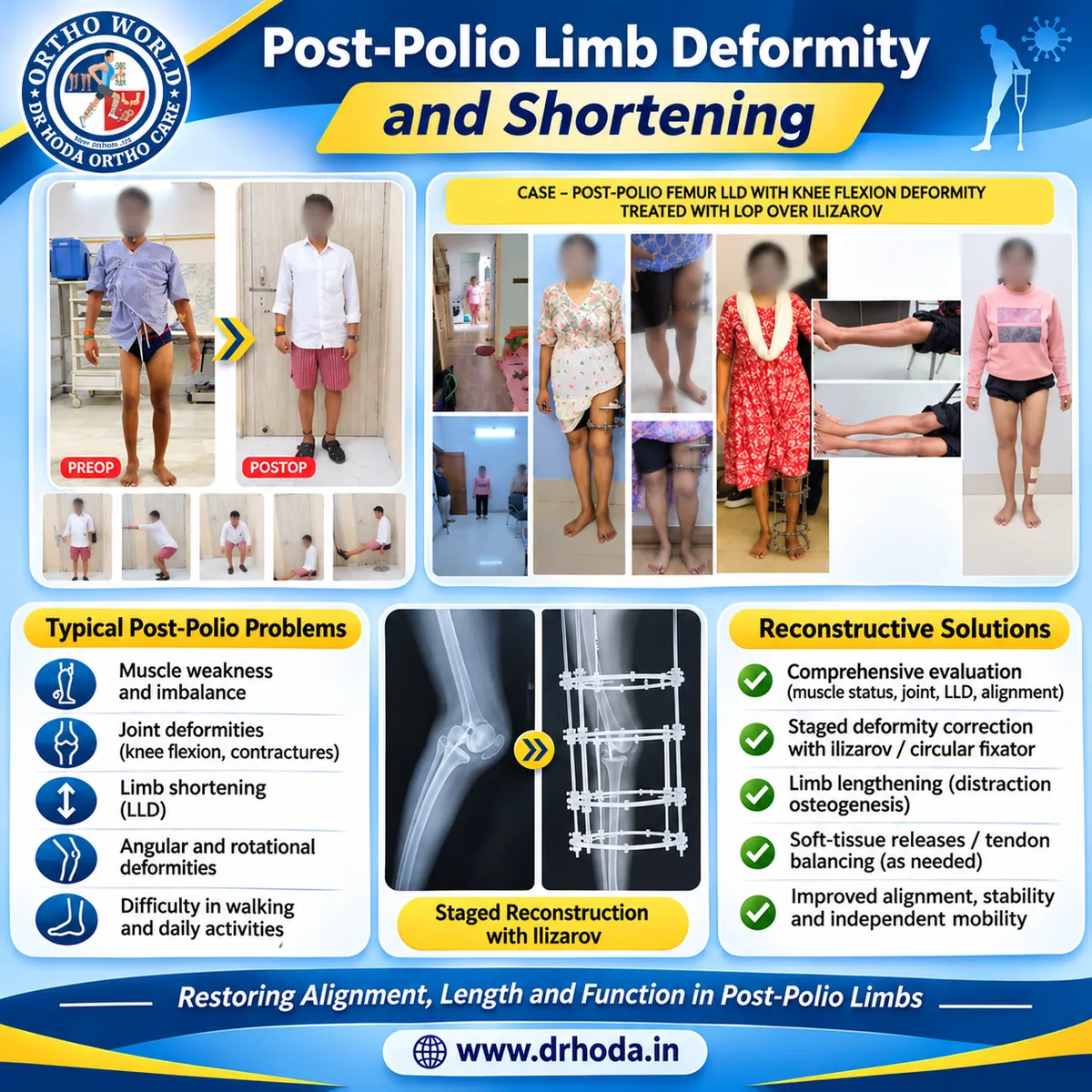
Polio can leave a leg weak, short and bent – often with a stiff knee or a foot that drops. Many adults with post-polio shortening can still improve their walking with planned reconstruction: correction of knee or ankle deformity, tendon procedures and lengthening, chosen after checking muscle strength and joint stability. Some patients still need a brace after surgery; we discuss this honestly before treatment. Read more about post-polio reconstruction →
Before surgery
- Blood tests, ECG and anaesthesia check-up
- Stop smoking, bidi and gutkha; control diabetes
- Begin the stretching exercises you are shown (exercise sheet)
- Plan who will help you at home and with the daily adjustments
- Insurance pre-authorisation is arranged by our team (insurance & schemes)
After surgery and at home
- Hospital stay is usually a few days.
- Pain is controlled with medicines; mild aching during adjustments is expected.
- Pin-site care exactly as taught (Hindi frame-care guide).
- Walking with a walker or crutches as advised.
- Physiotherapy several times a week during lengthening (rehabilitation centre).
- Protein-rich food; calcium and vitamin D as prescribed.
How long does treatment take?
Total time depends on the length gained and on age – children heal faster than adults. As a rough guide, the device often stays on about one to two months for every centimetre gained. You will receive your own expected time-line before surgery.
Benefits and risks
Possible benefits: more equal limbs, a better walking pattern, less back and hip strain, easier use of footwear, and in many cases correction of deformity at the same time.
Possible risks: pin-site infection (common and usually minor), joint stiffness or contracture, slow or early hardening of the new bone, nerve irritation, the need for further procedures, and fracture of the new bone after frame removal. Results depend on age, health, the condition treated and following the treatment plan. Dr. Hoda explains the risks that apply to you before you decide.
Will the lengthened limb work well?
Most patients return to walking and daily activities. Long-term function depends on the original condition, the strength of muscles and the health of the joints. Physiotherapy and follow-up are as important as the operation.
Our patients
Dr. Hoda’s own patients, shared with consent for education; faces and names are hidden. Results vary from patient to patient. Contains clinical and operative images.
Two lengthenings from Ortho World – a teenager with a leg shortened after injury, and a child with achondroplasia.

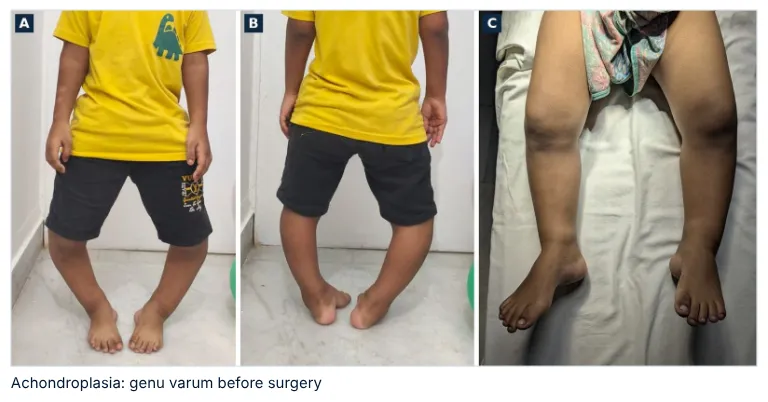
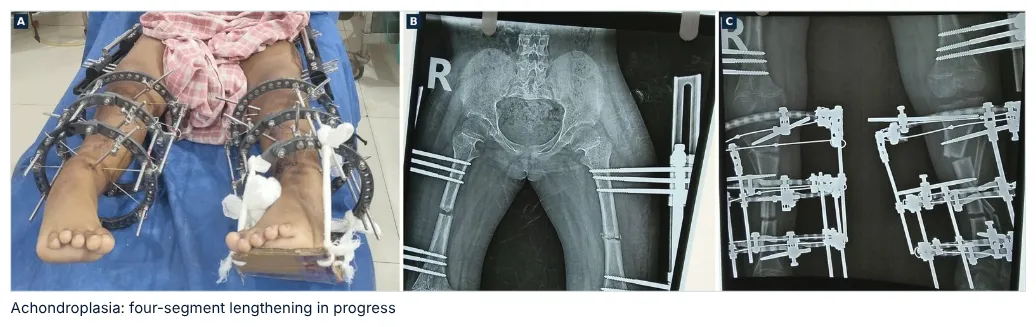
From the free textbook Ilizarov Principles & Limb Reconstruction – Chapter 69 · Chapter 69A · More in Clinical Cases.
Treatment in Patna & Hajipur
Consultations at Ortho World Patna (Kankarbagh) and Ortho World Hajipur. Surgery at Ortho World Hajipur, Rajeshwar Hospital or SS Hospital & Research Institute, Patna. Patients come from across Bihar, Jharkhand, Uttar Pradesh, the North-East, Nepal and Bangladesh – send your X-rays on WhatsApp for an initial opinion before travelling.
Watch: limb lengthening at Ortho World
 ▶
 ▶
 ▶
 ▶
 ▶
 ▶
 ▶
 ▶
 ▶
 ▶
When to call us immediately
Redness, pus or bad smell around a wound or pin · fever · increasing pain, numbness or tingling · a loose or broken wire, pin or ring · cold, pale or blue toes or fingers.
Patna +91 77658 67111 · Hajipur 24-hour emergency +91 70704 61111
Frequently asked questions
Does limb lengthening hurt?
Can I walk with the frame?
Can a polio-affected leg be lengthened?
Is limb lengthening safe for children?
Can I go to school or work during treatment?
Is it covered by insurance or Ayushman Bharat?
How do I get an opinion if I live far away?
A note from Dr. Shamsul Hoda
Limb lengthening is a journey, not a single operation. It needs patience, daily effort and close teamwork between the patient, the family, the physiotherapist and the surgeon. Our aim is to plan carefully, explain every step honestly, and stay with you until the end of treatment.
References
- Ilizarov GA. The tension-stress effect on the genesis and growth of tissues: Part I. Clin Orthop Relat Res. 1989;(238):249–281.
- Paley D. Problems, obstacles, and complications of limb lengthening by the Ilizarov technique. Clin Orthop Relat Res. 1990;(250):81–104.
- Paley D, Herzenberg JE, Paremain G, Bhave A. Femoral lengthening over an intramedullary nail. J Bone Joint Surg Am. 1997;79(10):1464–1480.
Related
Conditions A–Z · Treatments & Techniques · Digital planning · Deformity correction · Limb lengthening cost · Exercises during lengthening · Hybrid lengthening (for doctors)
Ready to discuss your case?
Book a consultation in Patna or Hajipur, or send your X-rays on WhatsApp for an initial opinion.