
Bow Leg, Knock Knee & Limb Deformity Correction in Patna
Gradual, precisely planned correction of bent, twisted or malaligned bones in children and adults – using the Ilizarov method and computer-assisted planning at Ortho World, Patna and Hajipur.
On this page
What is a limb deformity?Common causesWho may need treatment?How we plan your treatmentHow is it treated?Why gradual correction?Other options we will discussWhat to expectRisks and limitationsOur patientsTreatment in Patna & HajipurFAQWhat is a limb deformity?
A deformity means the bone is bent, twisted or out of line. The leg may look bowed (bow legs, genu varum), the knees may knock together (knock knees, genu valgum), or the foot may point inward or outward. Deformity changes the line along which body weight passes through the knee and ankle. Over years this can cause pain, a limp, unstable joints and early arthritis.
Common causes
- Rickets and other metabolic bone diseases
- Blount’s disease (growth disturbance at the top of the shin bone)
- A fracture that healed in a bent or rotated position (malunion)
- Growth-plate injury or infection in childhood
- Post-polio and other neuromuscular conditions
- Skeletal dysplasias such as achondroplasia
- Elbow deformity after a childhood fracture (cubitus varus)
Who may need treatment?
- Bowing or knock knees that persist or worsen after about age 7–8 years
- Deformity on one side only, or with leg-length difference
- Pain in the knee or ankle, frequent tripping, or difficulty running
- Deformity after a fracture or infection
- Adults with deformity and early joint pain
How we plan your treatment
Every deformity is measured on full-length standing X-rays and the correction is simulated on computer (Bone Ninja) before surgery. We show you the plan on screen. See how digital planning works →
How is it treated?
- Measurement – Full-length standing X-rays from hip to ankle. We measure the mechanical axis, joint angles (such as MPTA and LDFA) and find the exact level of deformity (CORA).
- Digital plan – The correction is simulated on computer before surgery and explained to you on screen.
- Surgery – A small bone cut (osteotomy) is made at the planned level and the Ilizarov or hexapod frame is applied. In growing children, guided growth with small plates may be enough.
- Gradual correction – The frame is adjusted a little every day, so nerves, vessels and soft tissues adapt safely. Limb lengthening can be done at the same time if the leg is also short.
- Consolidation and frame removal – Once the bone has healed in the corrected position, the frame is removed.
Why gradual correction?
- Large or complex (three-dimensional) deformities can be corrected safely
- The correction can be fine-tuned during treatment
- Shortening and deformity can be treated together
- Walking is usually encouraged during treatment
Other options we will discuss
Observation in normal childhood bowing · guided growth in growing children · bracing in selected cases · surgery with gradual or one-stage correction.
What to expect
Most patients walk with support while wearing the frame. Physiotherapy keeps the knee and ankle moving. Total frame time depends on age, bone and the amount of correction – usually several weeks to a few months. Regular X-rays check alignment and bone healing.
Risks and limitations
Pin-site infection, joint stiffness, delayed bone healing, under- or over-correction needing adjustment, and rarely nerve or blood-vessel problems. Dr. Hoda will explain the risks that apply to you before you decide.
Our patients
Dr. Hoda’s own patients, shared with consent for education; faces and names are hidden. Results vary from patient to patient. Contains clinical and operative images.
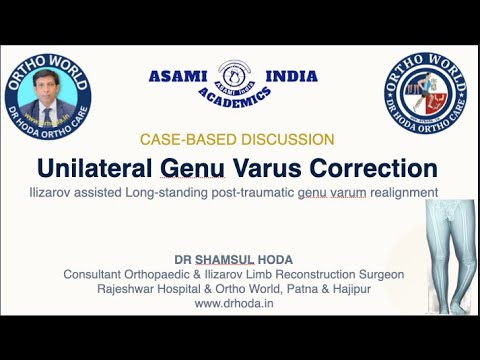
Bow legs, crooked bones after injury and growth-plate damage – corrected gradually in the frame.
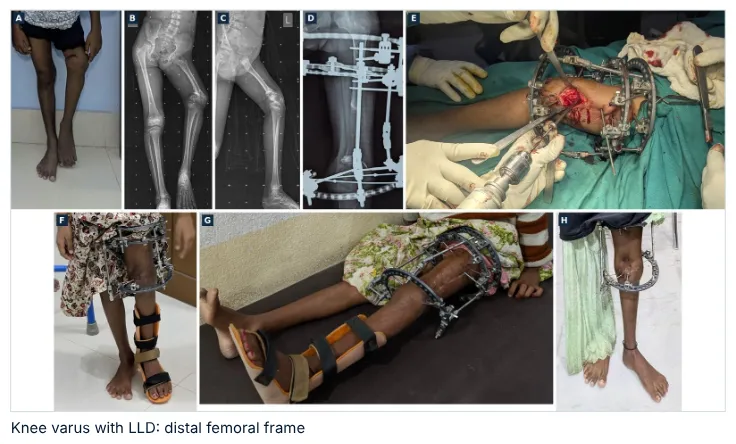
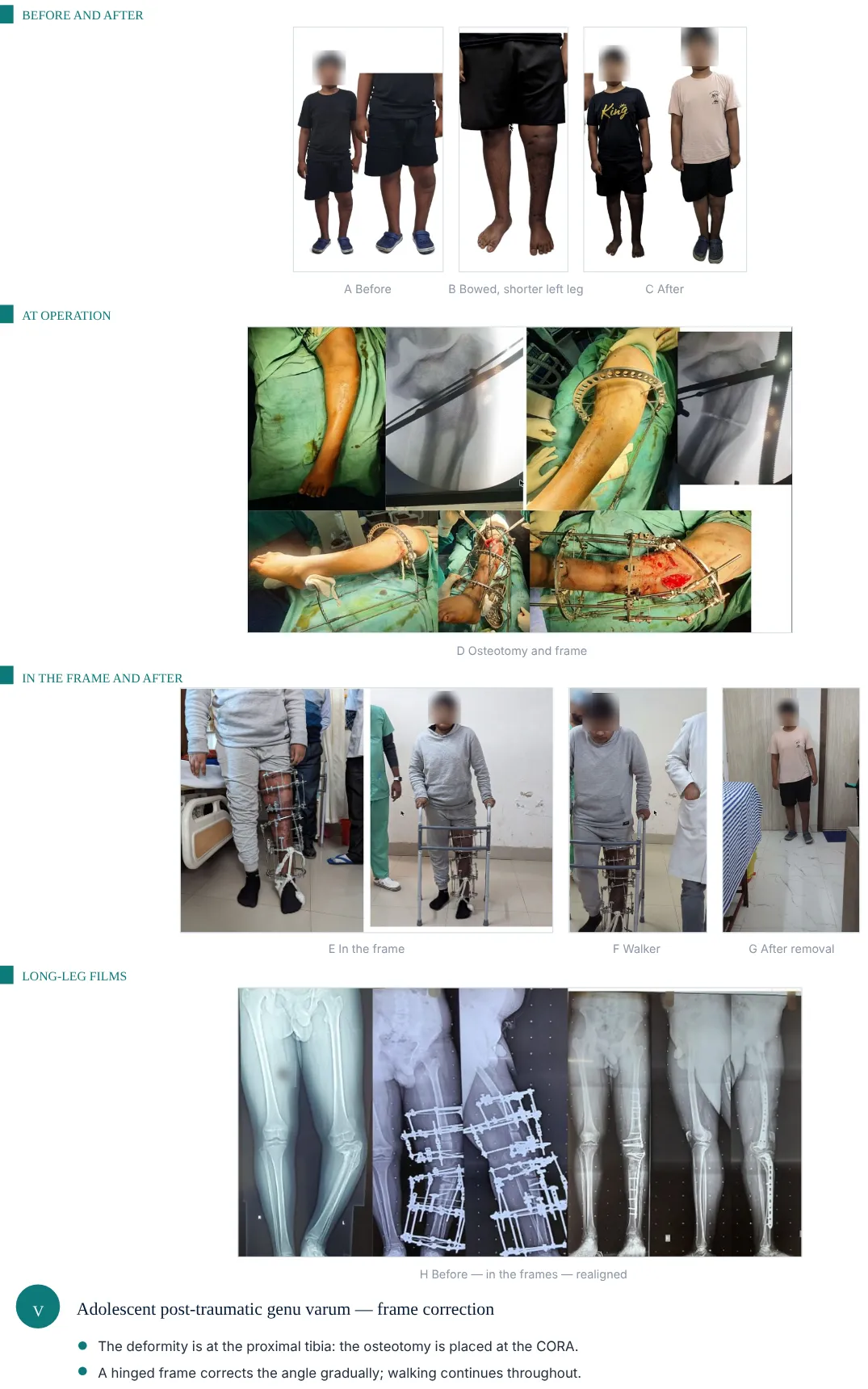
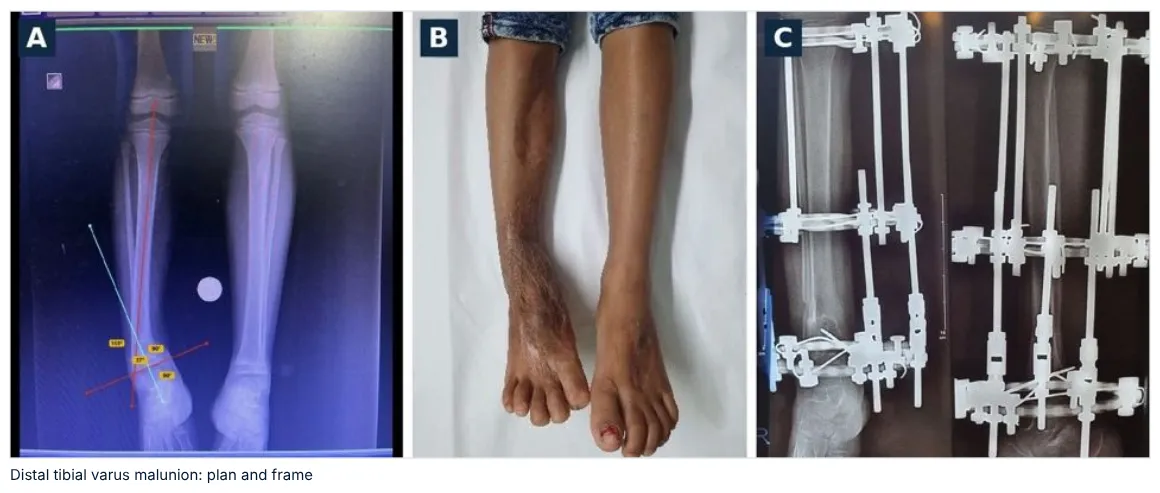
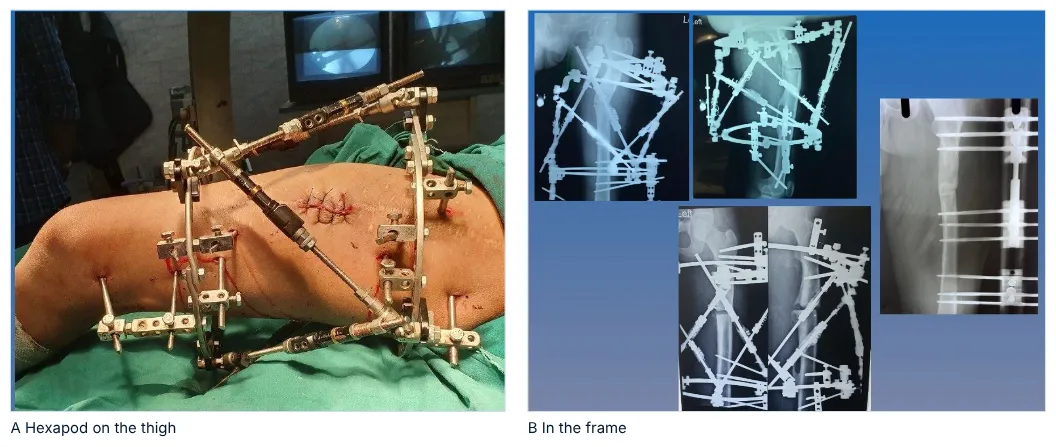
From the free textbook Ilizarov Principles & Limb Reconstruction – Chapter 97 · Chapter 98 · Chapter 96 · More in Clinical Cases.
Treatment in Patna & Hajipur
Consultations at Ortho World Patna (Kankarbagh) and Ortho World Hajipur. Surgery at Ortho World Hajipur, Rajeshwar Hospital or SS Hospital & Research Institute, Patna. Patients from outside Bihar can send X-rays on WhatsApp (77658 67111) for an initial opinion.
Watch
 ▶
 ▶
 ▶
 ▶
 ▶
 ▶
 ▶
 ▶
 ▶
 ▶
When to call us immediately
Redness, pus or bad smell around a wound or pin · fever · increasing pain, numbness or tingling · a loose or broken wire, pin or ring · cold, pale or blue toes or fingers.
Patna +91 77658 67111 · Hajipur 24-hour emergency +91 70704 61111
Frequently asked questions
Are bow legs in my toddler normal?
Can deformity be corrected without cutting the bone?
Can both legs be corrected together?
Will I need to stay in hospital for a long time?
Can rickets deformity be treated with medicine alone?
Is treatment covered by insurance or Ayushman Bharat?
A note from Dr. Shamsul Hoda
Every limb and every patient is different. We plan carefully, explain the options honestly and stay with you through recovery.
Related
Read: bow legs knock knees · Read: computer assisted deformity planning · Read: cubitus varus elbow deformity · Limb Lengthening · Clubfoot · Congenital conditions
Ready to discuss your case?
Book a consultation in Patna or Hajipur, or send your X-rays on WhatsApp for an initial opinion.
