
Most of what decides the result of a frame happens after the patient leaves theatre: quiet pin sites, a knee and ankle that keep their range, a patient who walks on the limb, and a frame that comes off at the right time.
Pin sites
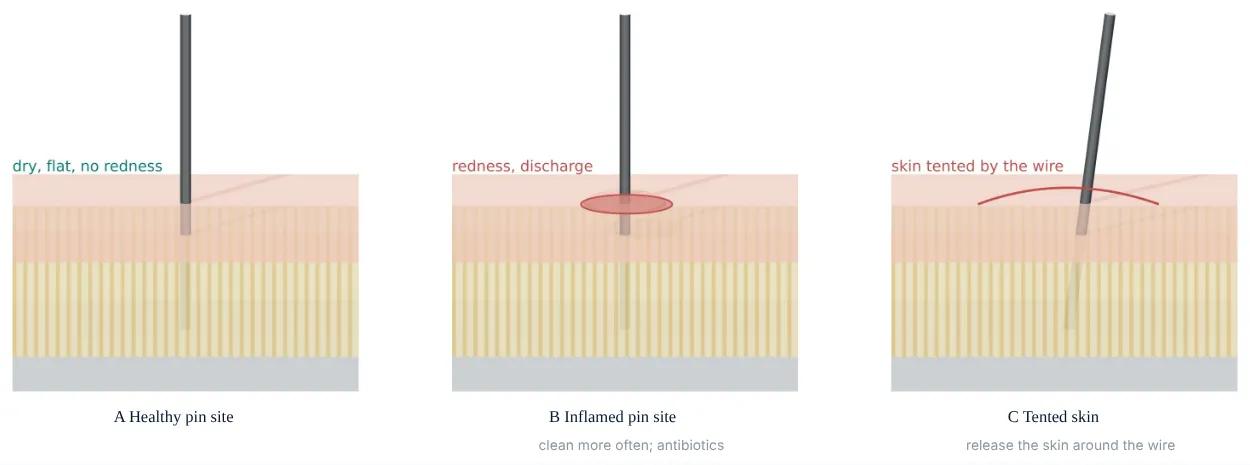
- Grade pin-site infection (Checketts–Otterburn): grades 1–3 are minor and treated with the frame in place; 4–6 are major.
- The evidence for any one cleaning solution is weak. What matters: daily inspection, simple cleaning, dressings that stop skin moving on the wire, and early oral antibiotics for redness with discharge.
- Tented skin must be released – it will not settle on its own.
Positioning and exercises

- Support the leg under the most distal ring – a pillow under the calf lets the foot fall into equinus and the knee bend into a contracture.
- Ankle pumps and heel slides many times an hour; quadriceps and straight-leg raises from day one.
- Extend the frame to the foot (or use a foot plate) when long transport or lengthening threatens equinus.
Weight-bearing
Walking in the frame loads the regenerate and the docking site and is part of treatment, not a reward at the end. Most patients walk with a walker or crutches from the first days, as pain allows.
When does the frame come off?
Three cortices of continuous regenerate on two views, then a trial of loosening (dynamisation) with walking – if there is no pain and no change in alignment, the frame is removed. Defects and open fractures fail more often, so be more cautious there.
[Chapter 70A – Postoperative Care in the Frame](https://ilizarovprinciples.com/chapters/070a-postoperative-care-in-the-frame/) · [Chapter 11 – Regenerate Formation & Maturation](https://ilizarovprinciples.com/chapters/011-regenerate-formation-and-maturation/)
From Ilizarov Principles & Limb Reconstruction by Dr. Shamsul Hoda – ilizarovprinciples.com. Figures reproduced from the book.
Lectures and surgical videos by Dr. Hoda
 ▶
 ▶
 ▶
References
- Checketts RG, MacEachern AG, Otterburn M. Pin track infection and the principles of pin site care. In: De Bastiani G, et al., eds. Orthofix External Fixation in Trauma and Orthopaedics. Springer; 2000.
Related
Pin-site care and pin-tract infection · After surgery & frame care (patients)
Ready to discuss your case?
Book a consultation in Patna or Hajipur, or send your X-rays on WhatsApp for an initial opinion.
